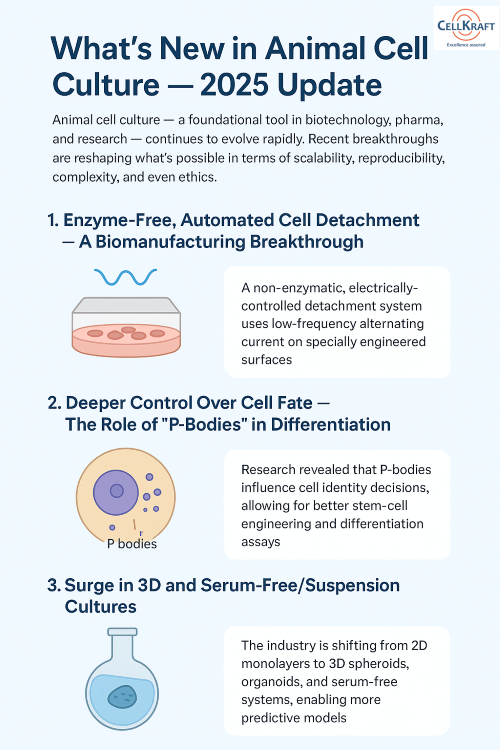
1. Enzyme-Free, Automated Cell Detachment — A Biomanufacturing Breakthrough
Traditional enzymatic detachment methods such as trypsinization can damage proteins on the cell surface and affect viability.
A new 2025 development introduces a non-enzymatic, electrically-controlled detachment system, allowing the release of anchored cells using low-frequency alternating current on specially engineered surfaces.
Why this matters
- Low cell stress → improved viability
- Marker integrity preserved → better for flow cytometry
- Moves cell culture toward animal-component-free, scalable harvesting
2. Deeper Control Over Cell Fate — The Role of “P-Bodies” in Differentiation
Researchers discovered that P-bodies — earlier believed to be simple RNA-degradation compartments — actually influence cell identity decisions. Manipulating P-body formation can push cells into more primitive or more specialized states.
Why this matters
- Better stem-cell engineering
- Improved differentiation assays
- Potential for cell-line customization in R&D and therapeutics
3. Surge in 3D and Serum-Free/Suspension Cultures
The industry is shifting from traditional 2D monolayers to 3D spheroids, organoids, and serum-free systems, which recreate in-vivo-like environments more accurately.
Benefits
- More predictive drug-response models
- Reduced animal-derived components
- Scalable production using suspension bioreactors
Conclusion
Animal cell culture is undergoing a rapid evolution — from enzyme-free harvesting to 3D systems, smarter monitoring, and deeper biological control.
At CellKraft we keep up with current innovations to offer:
- Advanced 3D assay services
- Marker-preserving detachment for flow cytometry
- Differentiation and stem-cell-based assays
- Large-scale, reproducible culture solutions