1. Wound Healing (Cell Migration) Assay
Primary Cosmetic Claims: Skin repair, barrier restoration, anti-aging, and scar reduction.
This assay evaluates the regenerative properties of cosmetic actives. We utilize the industry-standard in vitro “scratch assay,” where an artificial gap is created in a confluent monolayer of skin cells (typically epidermal keratinocytes or dermal fibroblasts). We then monitor and quantify the rate at which cells migrate and proliferate to “heal” and close the gap under the influence of the test product.
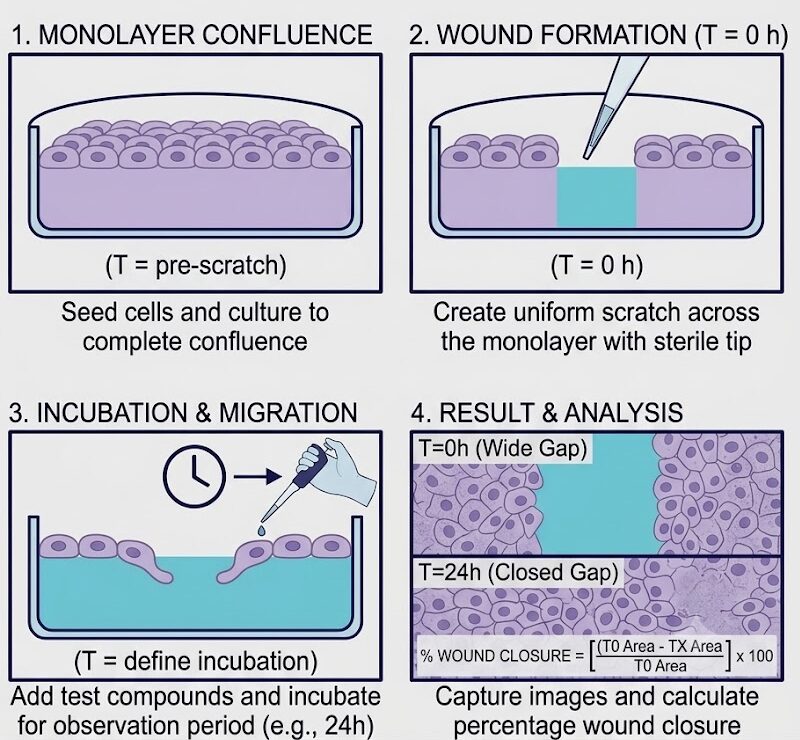
- Mechanism Tested: Cell proliferation and directed migration.
- Value: Provides compelling visual and quantitative data to substantiate claims for products aimed at repairing compromised skin barriers, post-treatment recovery, or overall cellular renewal.
2. Melanin Production (Melanogenesis) Assay
Primary Cosmetic Claims: Skin brightening, tone evening, dark-spot reduction, and hyperpigmentation control.
To validate skin-lightening or illuminating products, we measure a compound’s ability to regulate pigment formation. Using specialized melanocyte cultures, we quantify total intracellular melanin synthesis alongside the enzymatic activity of Tyrosinase—the critical catalyst in melanin production.
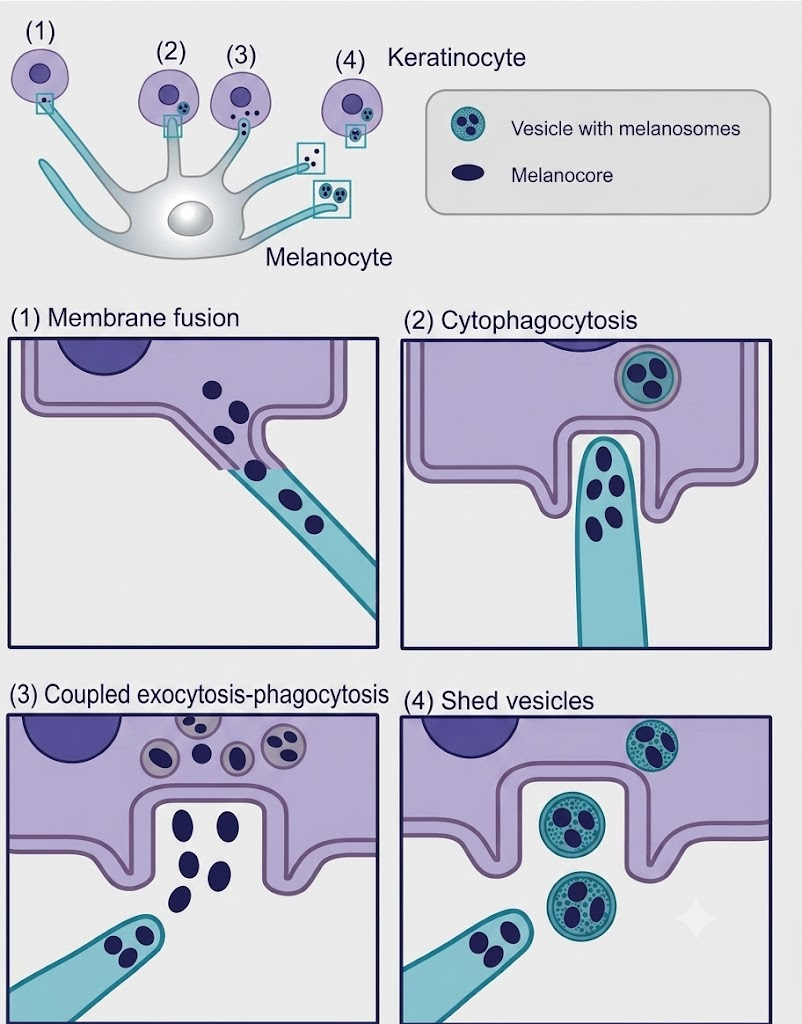
- Mechanism Tested: Tyrosinase inhibition and melanosome transfer down-regulation.
- Value: Allows formulators to prove that their active ingredients successfully intercept the biological pathways that cause age spots, sun damage, and uneven skin tone.
3. Nerve and Skin Tissue Interaction (Neuro-Cosmetics)
Primary Cosmetic Claims: Sensitive skin relief, anti-stinging, itch reduction, and “neuro-soothing.”
This is a highly advanced assay designed for the emerging field of neuro-cosmetics. Because skin is heavily innervated, cosmetic discomfort (stinging, burning) often stems from nerve-cell communication. We use sophisticated 2D or 3D co-culture models that integrate sensory neurons with keratinocytes or fibroblasts to observe their cross-talk.
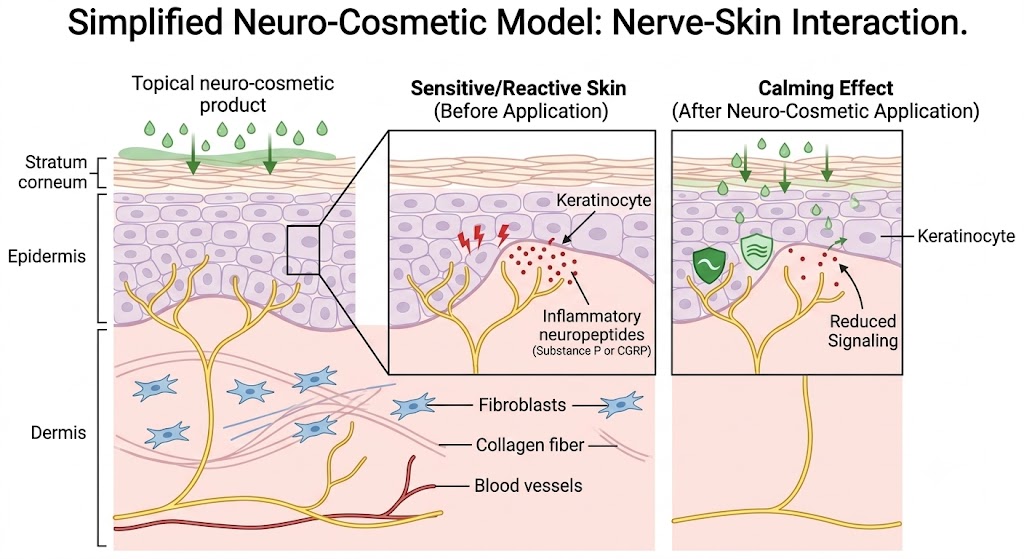
- Value: Essential for substantiating claims on products formulated for hyper-reactive, reactive, or sensitive skin types by proving the product successfully calms the skin’s neural network.
- By using these innervated models, we can substantiate high-value cosmetic claims by quantifying three critical mechanisms:
- Neuropeptide Release & Regulation (The “Soothing” Claim): When skin is stressed (e.g., by UV, chemicals, or temperature changes), nerves release pro-inflammatory neuropeptides like Substance P and CGRP, causing the sensations of stinging, itching, or burning. We measure a cosmetic active’s ability to intercept this communication and down-regulate these markers.
- Neurite Outgrowth (The “Neuro-Aging” Claim): As skin ages, the density of nerve endings decreases, leading to slower epidermal turnover and impaired wound healing. We use advanced imaging to measure the length and branching density of neurites (nerve fibers). Ingredients that stimulate neurite outgrowth (often via Nerve Growth Factor – NGF) support structural anti-aging and skin vitality.
4. Anti-Inflammatory Assay
Primary Cosmetic Claims: Calming, anti-redness, after-sun recovery, and pollution defense.
Inflammation is a primary driver of premature skin aging (“inflammaging”) and skin sensitization. In this assay, we induce stress in skin cell cultures using triggers like UV radiation, chemical irritants, or environmental pollutants. We then apply the cosmetic active and measure its ability to suppress the inflammatory response.
- Mechanism Tested: Quantification of key pro-inflammatory biomarkers and cytokines (such as IL-1α, IL-6, TNF-α, or PGE2) using ELISA or multiplex technologies.
- Value: Delivers hard data proving that a botanical extract, peptide, or formulation effectively intercepts the inflammatory cascade, reducing redness and defending the skin against daily environmental stressors.
5. Osteoblast Differentiation Assay
Primary Cosmetic Claims: Facial volume retention, structural anti-aging, deep contouring, and “beauty-from-within” (nutricosmetics) support.
Visible facial aging is not solely caused by collagen degradation in the skin; it is heavily influenced by the natural resorption and thinning of the underlying facial bones (maxilla and mandible), which leads to sagging and volume loss. This specialized assay evaluates whether an active ingredient or ingestible compound can stimulate bone-forming cells to maintain this critical structural scaffolding.
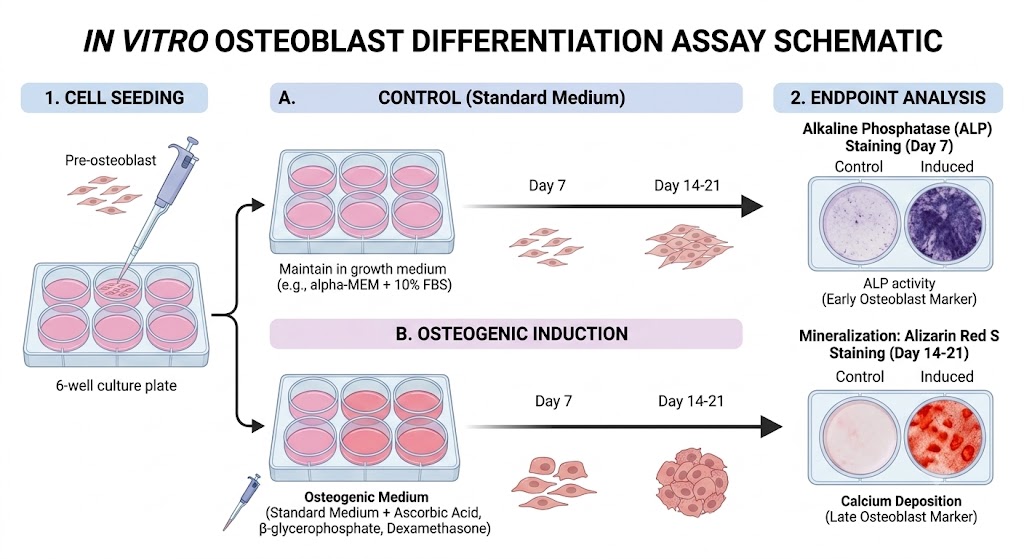
Mechanism Tested: We culture human osteoblasts (or their stem cell precursors) alongside the test active, measuring biomarkers of bone formation such as Alkaline Phosphatase (ALP) activity, Type I Collagen synthesis, and the ultimate formation of mineralized calcium deposits (nodules) using specific biological stains.
Value: Provides cutting-edge, highly differentiated claim substantiation for holistic anti-aging brands, proving their formulas target aging at the deepest structural level to help maintain youthful facial contours.